From Wikipedia we have for a ring  and a group
  a new ring written as
  that is defined on the functions
  with finite support and addition and multiplication defined as follows.
![\[\sum\limits_{g \in \mathcal{G}} \phi_g g \ + \ \sum\limits_{g \in \mathcal{G}} \psi_g g \ := \ \sum\limits_{g \in \mathcal{G}} \left( \phi_g + \psi_g \right) g\]](http://mathematics.steffenzopf.de/wp-content/ql-cache/quicklatex.com-65ff7976448b53b002d8be9e9f841f82_l3.png "Rendered by QuickLaTeX.com")
and
![\[\sum\limits_{g \in \mathcal{G}} \phi_g g \ \cdot \ \sum\limits_{g \in \mathcal{G}} \psi_g g \ := \ \sum\limits_{g \in \mathcal{G}} \left( \sum\limits_{u,v \in \mathcal{G} | uv = g} \phi_u \cdot \psi_v \right) g \ = \ \sum\limits_{g \in \mathcal{G}} \left( \sum\limits_{h \in \mathcal{G}} \phi_{h} \cdot \psi_{h^{-1}g} \right) g\]](http://mathematics.steffenzopf.de/wp-content/ql-cache/quicklatex.com-81fb299aa26cbde83a45014c7c015081_l3.png "Rendered by QuickLaTeX.com")
Here,  stands for a (formal) sum of elements of with coefficients taken from the ring . This makes sense as long as the functions in question have finite support, i.e.
  .
.
The group ring is written ![\mathcal{R}\left[ \mathcal{G} \right]](http://mathematics.steffenzopf.de/wp-content/ql-cache/quicklatex.com-6bb153f70efd22bf058c4635e6b0e583_l3.png "Rendered by QuickLaTeX.com") . It is clear that the group ring is also a module over the ring . For an element
. It is clear that the group ring is also a module over the ring . For an element  let us define the following mapping (action) on the group ring
![\[\Phi_g \,:\, \mathcal{R}\left[ \mathcal{G} \right] \ni \sum\limits_{h \in \mathcal{G}} \phi_h h \longmapsto \sum\limits_{h \in \mathcal{G}} \phi_{h} (gh) \,=\, \sum\limits_{h \in \mathcal{G}} \phi_{g^{-1}h} h \in \mathcal{R}\left[ \mathcal{G} \right]\]](http://mathematics.steffenzopf.de/wp-content/ql-cache/quicklatex.com-13b82d7da3c2b2f4ebf6737097deb96b_l3.png "Rendered by QuickLaTeX.com")
This is nothing else but a representation of the group on the linear mappings of the group ring as a module.
If is a field the group ring is called a group algebra over the field. In this case the group action from above is nothing else but a representation of the group on the linear mappings of the group algebra as a vector space.
As an example let us investigate the (multiplicative) group of the  -th unit roots,
  . Then we have for an arbitrary ring an element of
 ![\mathcal{R}\left[\mathcal{G}\right]](http://mathematics.steffenzopf.de/wp-content/ql-cache/quicklatex.com-b7dd1724cad4a6ed744ba00ad56522f9_l3.png "Rendered by QuickLaTeX.com") :
:
![\[r_0\,\mathbf{e}_0 + r_1\,\mathbf{e}_1 + r_2\,\mathbf{e}_2 + \ldots + r_{n-1} \,\mathbf{e}_{n-1}\]](http://mathematics.steffenzopf.de/wp-content/ql-cache/quicklatex.com-ae4db16832dcffb56c3ceb64ec57589e_l3.png "Rendered by QuickLaTeX.com")
with
![\[\mathcal{G} \ni \mathbf{e}_k \,:=\, e^{\frac{2\pi i k}{n}} \quad\text{and}\quad r_k \in \mathcal{R} \ \left(k = 0, 1, \ldots, n-1 \right) \ .\]](http://mathematics.steffenzopf.de/wp-content/ql-cache/quicklatex.com-878dab5940c09589f5b90c4b2fc4a298_l3.png "Rendered by QuickLaTeX.com")
For a product of 2 elements we get
(1) 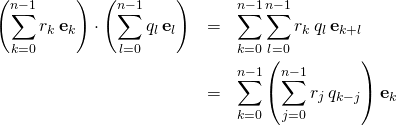
taking  and analogously for
  . The coefficients of the product are the result of a convolution of the two -element series
  and
and  .
.